
Seagull Miracle

To watch on Youtube click here: https://youtu.be/TFbPwQNKAgA
To listen on Spotify click here: https://open.spotify.com/episode/3b49faBAbWAcBk4MHaprN2?si=XhTksVXmQHy_qh-guAGD1w
Brigham Young led the member of The Church of Jesus Christ of Latter-day Saints across the country to the barren land of Utah. The first group of Saints were called to shoulder a great burden in preparing the land and the area for the rest of the Latter-day Saints to come and live. The Latter-day Saint leadership had a lot of experience building cities, being driven out of multiple areas. This experience was a great blessing for the Saints as they came to Utah.
The Prophet Joseph Smith had drawn up a "plat for Zion" in 1833, a design for a city unit one mile square divided into forty-nine square lots laid out on a perfect grid. The three central lots were reserved for the temples, storehouse, offices, and any other facilities the Church required. When one plat was fully occupied, they would lay out another adjacent to it, repeating the process as necessary during the city's growth, so it would remain neat and organized. Nauvoo had risen from a swamp in just a few years using Joseph's plan. In Salt Lake they would use a version of this same system. In Salt Lake they decided they would use ten ache blocks laid out on a perfect grid that lined up in the four cardinal directions, each with lots measuring ten rods by twenty covering an acre and a quarter of land. Brigham wanted only one house on each lot built in the center so that "if they took fire they would not burn up their neighbors."
Brigham's first great worry was food for all the Latter-day Saints, in his wagon company and the companies that followed. Brigham had chosen extremely hardworking Saints to accompany him to the Valley. These men and women knew they were responsible to pave the way for the next group. Prepping the land, and the area for the thousands coming was a great responsibility, and this group of people did a magnificent job, they were a blessing to so many.
The Saints in Brighams company wasted no time, but got to work on planting crops immediately. Arriving in late July did not give this group much time, and they feared that it was just not enough time to get the crops planted and a good harvest before the cold. The Saints had received reports that winter in the area was known to come early in past years, and snow could fall by the foot. These Saints got to work, knowing that it would take constant labor to reach the quota needed. These Saints worked in shifts, breaking ground plot after plot.
After only one week of hard work, the Sabbath excepted, these incredible Saints had "thirty-five acres planted in corn, oats, buckwheat, potatoes, beans, and garden seed." They soon had that number up to eighty acres.
These hard-working Saints kept going, planting plot after plot, and by the time the weather turned cold, they had planted 875 acres of winter wheat, so they could harvest the grain in the early spring before they started again with corn, potatoes and the rest.
The Latter-day Saints were fortunate that first winter of 1848, it was not a harsh winter in the Salt Lake Valley. The Saints were able to to continue to plow and sow their winter wheat. By the spring they had 5,133 acres of land tilled with 872 sown with winter wheat. Even with these great efforts they did not have food in the abundance they needed. Families needed to ration their flour. The Saints used wild sego and parsnip root scrounged from the valley floor as frequent additions to their meals, later they added thistle tops.
Even in the very difficult conditions no one starved to death, and that was a great blessing.
With great effort the Saints made it through the first winter in the Utah Territory. There was a terrible mice problem the first winter, with a wet winter and the houses were not built with adiquate drainage, it was a wet miserable winter, but they made it!
The Spring brought new hope for the Saints but it also brought new problems. All the crops the Saints had worked on and the land prepared brought an invasion of crickets. These bugs threatened this new cities survival. Crickets were not new to the area, the Ute tribe harvested and stored the crickets as a source of winter food. Now the insects were feasting on the crops of this new settlement. Hordes of crickets devoured every plant in their path, sparing nothing. The Saints were facing a potential famine for a second winter in a row.
Mrs. Lorenzo Dow Young wrote: "We have grappled with the frost. . . but today to our utter astonishment, the crickets came by millions, sweeping everything before them. They first attacked a patch of beans for us and in twenty minutes there was not a vestige of them to be seen. They next sweep over peas, then came into our garden; took everything clean. We went out with brush and undertook to drive them, but they were too strong for us."
Eliza R. Snow recorded: "This morning's frost in unison with the ravages of the crickets for a few days past produces many sighs, and occasionally some long faces."
Lack of moisture also brought discouragement, according to Isaac Haight.
"Quite cold and very dry. Crops begin to suffer for want of rain," Haight wrote. "The crickets destroyed some crops and are eating the heads off the grain as soon as it heads out. The prospects for grain are discouraging."
Mrs. Lorenzo Young's descriptions that day are similar:
[May] 28th: Last night we had a severe frost. Today the crickets have commenced on our corn and small grain. They have eaten off 12 acres for Brother Rosacrants, 7 for Charles and are now taking Edmunds.
The horror of crickets engulfing fields, barns, houses, clothes, and cupboards continued day after day. Mrs. Lorenzo Young began to fear for the future outcome:
Today [May 29] they have destroyed 3/4 of an acre of squashes, our flax, two acres of millet and our rye, and are now to work in our wheat. What will be the result we know not.
That the quantity of crickets destroying the vegetation was overwhelming is clearly shown in John Steele's "catch-up" journal entry which summarized at least a week of destruction:
Sunday, June 4th, there is a great excitement in camp. There has come a frost which took beans, corn and wheat and nearly everything, and to help make the disaster complete, the crickets came by the thousands of tons.
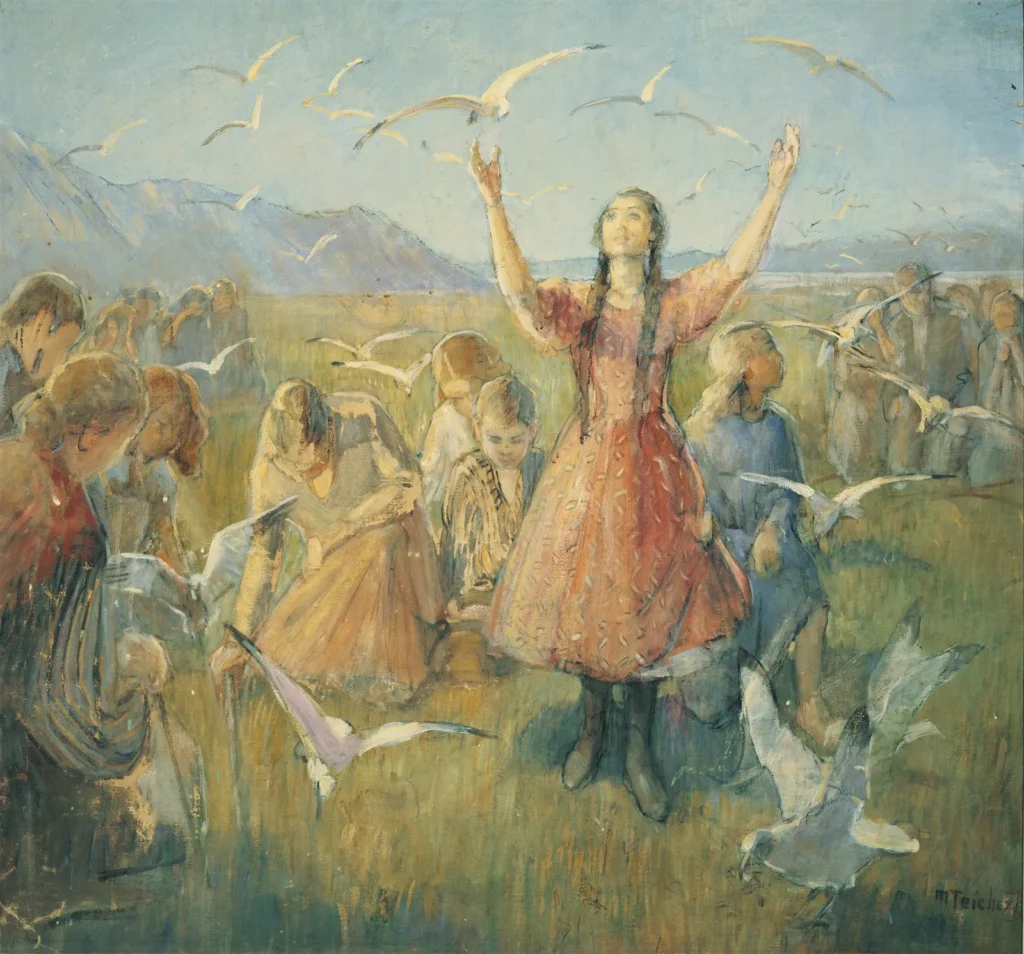
The harrassed farmers "prayed and fought and fought and prayed" for almost two weeks against the crickets — which some Mormons jokingly described as a cross between the spider and the buffalo. It is difficult to pinpoint exactly when the California gulls first arrived to assist, but on June 9 the Valley leaders described the dramatic event in a letter to Brigham Young: "The sea gulls have come in large flocks from the lake and sweep the crickets as they go; it seems the hand of the Lord is in our favor." Daily the gulls flew to the Mormon fields to consume crickets. Twelve days later another letter to Brigham Young noted the continuing activity of the crickets despite the gulls: "Crickets are still quite numerous and busy eating but between the gulls and our own efforts and the growth of our crops we shall raise much grain in spite of them." Patriarch John Smith remembered that the gulls "came every morning for about three weeks, when their mission was apparently ended, and they ceased coming." It appears that the 1848 cricket invasion lasted for at least a month and probably longer. In that time crickets had eaten grain clean two or three times in some fields.
John Smith left this description:
"The first I knew of the gulls, I heard their sharp cry. Upon looking up I beheld what appeared like a vast flock of pigeons coming from the Northwest. It was about three o'clock in the afternoon. . . . There must have been thousands of them. Their coming was like a great cloud; and when they passed between us and the sun, a shadow covered the field. I could see gulls settling for more than a mile around us."
The California gulls, now assumed to be regular inhabitants of the Great Salt Lake region during spring and summer months, astonished the new inhabitants of the Great Salt Lake Valley by the amount of crickets they killed but also by the unusual manner of consumption. The gulls would feed on crickets until full, drink some water, and then regurgitate prior to consuming more crickets.
This gave the impression to the Saints that the main objective of the gulls was to kill crickets rather than to feed on them. George Q. Cannon, for example, received such an impression after walking along water ditches where he saw "lumps of these crickets vomited up by those gulls." Now we know that such vomiting by gulls is not unusual. Responding to Cannon's description, one expert said that "these 'lumps of crickets' were undoubtedly 'pellets' of indigestible parts habitually disgorged by the birds."
The High Council Presidency, in evaluating the Valley's agricultural situation for Brigham Young on July 21, 1848, rated the gulls as helpers but certainly not as rescuers:
"The brethren have been busy for some time watering their wheat and as far as it is done the wheat looks well and the heads are long and large. The crickets are still quite numerous and busy eating, but between the gulls and our own efforts and the growth of our crops we shall raise much grain in spite of them. Our vines, beans and peas are mostly destroyed by frost and the crickets; but many of us have more seed and are now busy replanting. . . . Some of our corn has been destroyed, but many large fields look very well and corn is growing very fast."
"Like numerous other popular accounts of important and unusual historical events, the details of the Cricket War of 1848 over the years have been oversimplified, improved upon, and given somewhat legendary characteristics," Hartley wrote. "The fact remains, nonetheless, that the 1848 Mormon pioneers would have suffered more than they did had not the gulls come to their aid. Physically, the gulls helped avert a complete agricultural disaster. . . . The 'Miracle of the Gulls' story remains appropriate as an expression of faith held by Mormon pioneers and their descendants."
Definition of Miracle on the Church site: “A miracle is an extraordinary event caused by the power of God. … Miracles are an important element in the work of Jesus Christ. … They include healings, restoring the dead to life, and resurrection. Miracles are a part of the gospel of Jesus Christ. Faith is necessary in order for miracles to be manifested.”
References:
"40 yearsn the Saga of Building the Salt Lake Temple" p. 22
https://www.ldsliving.com/was-the-miracle-of-the-gulls-exaggerated-lds-historians-explain/s/88952
https://issuu.com/utah10/docs/uhq_volume38_1970_number3/s/107089
Related Posts
Salt Lake Temple Stories: 10 Years of Peace Prediction, Then, The Utah War
October 13, 2026
To watch on Youtube click here: https://youtu.be/R-16JqaTyTA To listen on Spotify click here:...

Pres. Nelsons Vision of Two Little Girls "We're Not Sealed to Anyone"
September 30, 2026
To watch on Youtube click here: https://youtu.be/BZjuOsGWHVI To listen on Spotify click here:...

The Boy in the Grease Pit
September 21, 2026
To watch on Youtube click here:https://youtu.be/DsnWiXrgwoE To listen on Spotify click here:...
Russell M. Nelson Inspired Heart Surgery on St. George Patriarch
September 15, 2026
To watch on Youtube click here: https://youtu.be/HvhMi1TxjgY To listen on Spotify click here:...
Joseph Smith Family Search Memories
July 14, 2026
There are many inspiring stories about the Prophet Joseph Smith. He was sent by a loving Father in Heaven to teach His children on Earth. There are...

The Other Eminent Men of Wilford Woodruff
June 5, 2026
Artwork credit: Vision of Wilford Woodruff, by Ken Corbett To watch on Youtube click here: https://youtu.be/vMDMss6lGrQ To listen on Spotify click...

Salt Lake Temple Stories: Cornerstone Ceremony of the Salt Lake City Temple
May 23, 2026
To watch on Youtube click here: https://youtu.be/QE6ldwnyGJU To listen on Spotify click here:...

Who's Looking for Me? President Nelsons Story
May 18, 2026
To listen on Spotify click here: https://open.spotify.com/episode/2XnAptPeygDlV02X1byiU9?si=bz8pm2oYR5qo3x_Mm31RSQ To watch on Youtube click here:...

Thomas S. Monson on Visiting the Sick
May 18, 2026
To watch on Youtube click here:https://youtu.be/BYbMwE3T2p0 To listen on spotify click here:...

Spencer W. Kimball's Heart Operation by Russell M. Nelson
March 20, 2026
To listen on Spotify click here: To watch on Youtube click here: https://youtu.be/Op5lef0Ljug While in Manchester England, in 1971, Spencer W....